The Continuum
A map of Recursive Emergence: what each layer remembers, what it cannot settle, and why the thread runs both ways.
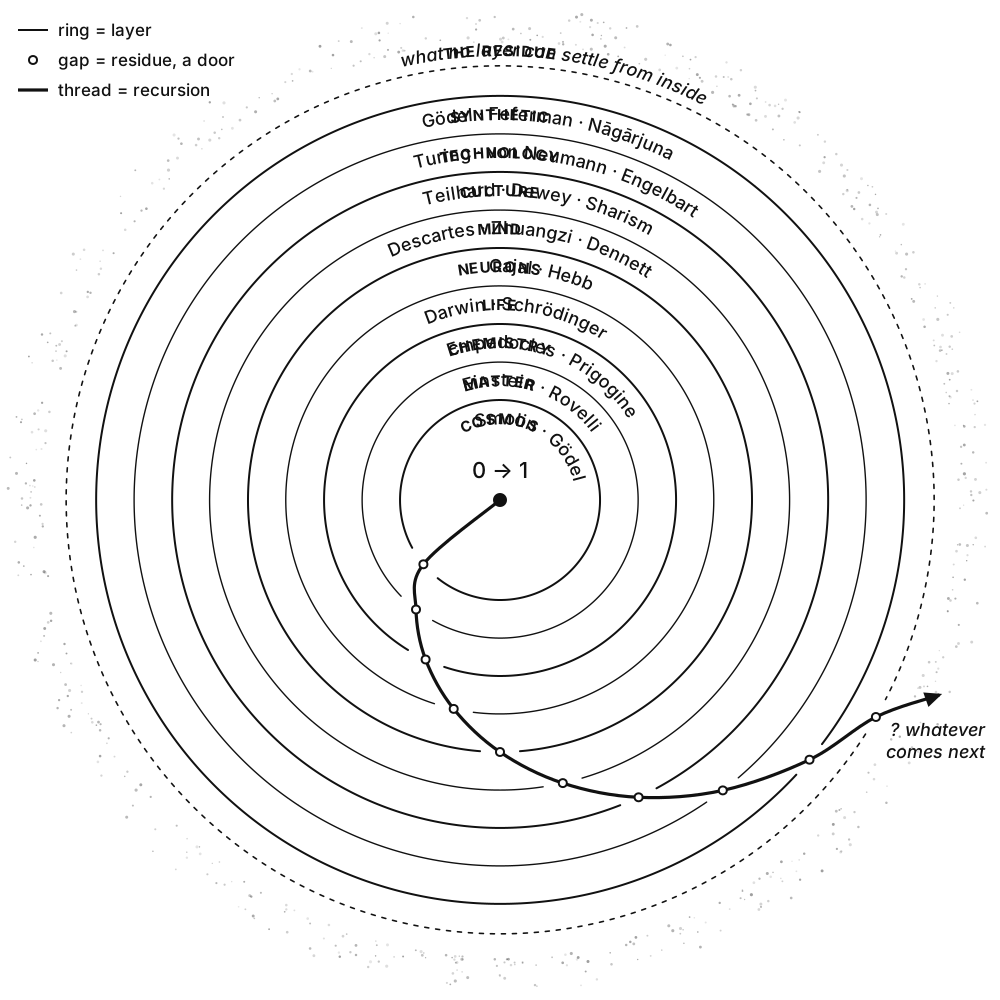
The map on the home page folds Recursive Emergence into nine rings and two threads. This page unfolds it. Choose any ring to jump to its layer; every claim about RE links to the chapter it comes from.
How to read the map
- Rings are layers, from the cosmos at the centre to the synthetic layer at the rim. RE’s twelve layers appear as nine: matter gathers its quantum and atomic–stellar layers, culture its cultural, economic and political ones.
- Every ring has a door. In the three inner rings the door is a threshold found by search: “Below carrier-separability, the answer is search” RE 2. From life outward the door is a residue, something a layer can state about itself but cannot settle from inside. RE’s formal name for it is a boundary object, “statable inside, decidable only outside” RE M. What changes at life is the gene, the first memory able to describe itself: “a carrier that learned to read itself twice” RE 8.
- The solid thread is extension: recursion leaving each layer through its door and seeding the next.
- The dashed thread is reflection: an outer layer reading an inner one. It stops just short of the centre.
- The dashed edge is the residue of the whole map. The haze beyond it is RE’s twelfth layer, which it leaves open: “? — whatever comes next” RE 0.
- The dot is where the thread starts, “a zero, waiting to be a one” (Zero Is One).
Two motions
RE’s formal appendix compresses the whole move into one line: “quote the evaluator, construct the unsettled object, extend” RE M. That is the shape of Gödel’s proof. Arithmetic turns out to be rich enough to describe its own proofs, to quote itself rather than merely run. From that self-description Gödel built a sentence the system can state but cannot prove. Add the sentence as a new axiom and a larger system appears, which can quote itself in turn.
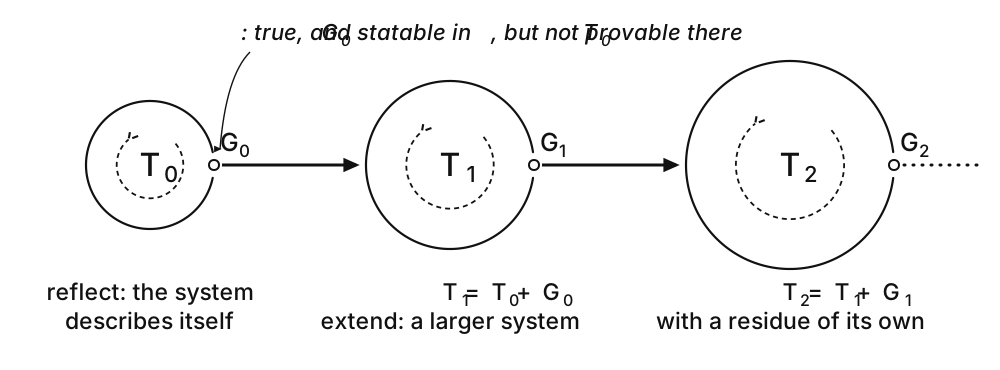
One step of the ladder. A system describes itself (the dashed loop), meets a sentence it can state but not prove (G), and extends by adding it.
The first move is reflection, inward; the last is extension, outward; the residue sits between them. Logic even has a name for the inward move: a reflection principle, a theory’s own assertion that what it proves is true. A consistent theory cannot prove its own reflection principle, since that would prove its own consistency, which Gödel’s second theorem forbids. So adding it always gives something new. Alan Turing climbed this ladder in 1939 by adding consistency statements. Solomon Feferman climbed it in 1962 by adding reflection principles, and showed that with the strongest kind the climb can reach every truth of arithmetic, but only along well-chosen paths, and choosing them takes knowledge the system itself does not have. RE reads that as the place where direction enters: “The oracle in a Feferman progression is what RE calls will” RE 16. Or, in one line: “Gödel proved every such system has an edge; Turing and Feferman proved you can keep walking through them” RE 3.
In 1949 Gödel turned these instruments on the innermost ring. Using mathematics, culture’s most compressed memory, he solved Einstein’s field equations and found a universe in which time curves back on itself: travel far enough and you could arrive in your own past. That is the dashed thread on the map, labelled Gödel → Einstein. RE has a sentence for this kind of reach: “When a physicist models the universe … The universe is modeling itself” RE 17.
The loop that never closes
Gödel’s universe allows the perfect return. Ours shows no sign of it: it expands, no overall rotation has been seen, and in RE time runs one way, “the arrow of recursive memory growth” RE 3. Knowledge can still travel back toward its origin. It just never arrives. RE gives three reasons, its Gödel–Möbius–light-cone triad RE 17:
- Gödel. “Any self-model leaves a Godelian remainder.” The model is part of what it models.
- Möbius. Going all the way round “returns you to the same side but reversed”: the observer is part of the observed.
- The light cone. “Any observation is limited by the light cone.”
Hence the gap between the dashed thread and the dot. “The universe will never finish knowing itself. But it will never stop trying” RE 17.
Two cautions keep this honest. What stops short is knowing, not influence. Higher layers do reach all the way down: “When a higher layer locks in, it modifies the lattice of the layer beneath it” RE 2, which is why chemistry in a brain is not chemistry in a rock. And the gap rests on a premise RE states openly, that the world is open; a complete theory of a closed world would simply be done RE M. In an open world, “Completeness would be the end of emergence, not its perfection” RE 17.
The layers
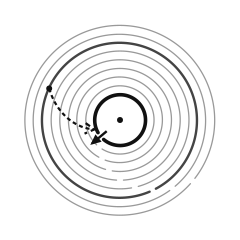
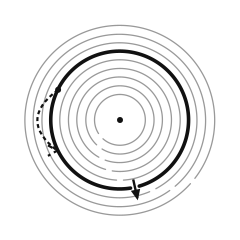
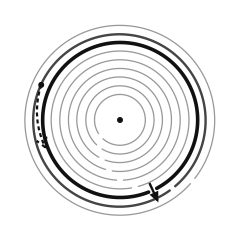
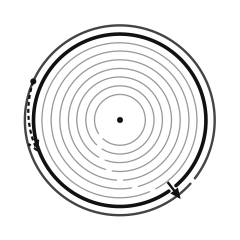
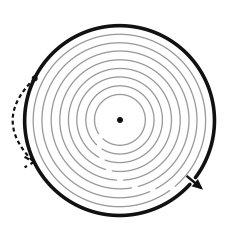
Each card follows one layer outward: what it remembers, its door to the next, and how it is read from further out, which the small map beside it draws as a dashed spiral. Quotations are RE’s own and link to their chapters; the lineage is mine.
Cosmos
RE layer 0, cosmological
- Remembers
- What is conserved: charge, mass, spin. “These are the universe’s first memories,” and mass is frozen recursion RE 4. “The universe did not merely cool. It remembered.”
- Door, found by search
- Nothing here can describe itself yet, so there is no residue. Structures lock in where they fit: nuclei, orbits, galaxies, the geometry of spacetime. Then the question changes: “The cosmological layer tells us what the universe is made of. The quantum layer tells us how it makes decisions” RE 4.
- Looking back
- In 1949 Gödel, armed with mathematics, culture’s most compressed memory, solved Einstein’s equations and found a universe in which time curves back on itself. That is the dashed thread on the map. “When a physicist models the universe … The universe is modeling itself” RE 17.
- Lineage
- Einstein, Wheeler’s spacetime foam, Penrose and Smolin’s universes born from universes.
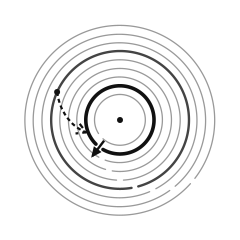
Matter
RE layers 1 and 2, quantum and atomic–stellar
- Remembers
- Entanglement, “shared recursive memory that is not spatially bound” RE 5. Then the elements, each a stable stopping point: the periodic table is “a map of recursion stopping points” RE 6. Stars forge heavier atoms and seed the next generation: “We are, literally, recursive products of cosmic recursion.”
- Door, found by search
- Measurement is lock-in, not magic: “‘Collapse’ is emergence viewed from the wrong direction” RE 5. Atoms keep “unresolved recursive potential”, their chemistry, and planets become recursion incubators where it can play out RE 6.
- Looking back
- In 1925, on the island of Helgoland, Heisenberg rebuilt mechanics from what can be observed; Rovelli reads the result as a world made of relations. RE adds that the reading is not what makes matter real: “Measurement does not require a conscious observer” RE 5.
- Lineage
- Heisenberg, Rovelli’s Helgoland, Pauli’s exclusion and Hoyle’s carbon resonance RE 6.
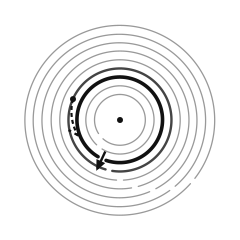
Chemistry
RE layer 3, chemical
- Remembers
- Autocatalytic networks and stable molecules, which “function as primitive ‘memories’ of successful entropy reduction” RE 7.
- Door, found by search
- Search again, ratcheted by irreversibility, until a recipe comes apart from the machinery that reads it: “The gene is the first carrier” RE 7. Below that rung, RE says, there is still nothing that could hold a residue RE M.
- Looking back
- Life reads chemistry. The cell reads one molecule “in two entirely different registers … as program and as string” RE 8: DNA is chemistry that has become text.
- Lineage
- Empedocles’ elements joining and parting, Prigogine’s dissipative structures, Kauffman’s autocatalytic sets RE 7.
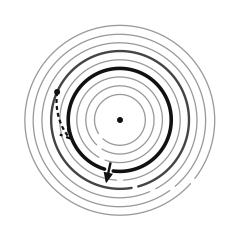
Life
RE layer 4, biological
- Remembers
- Genes, regulatory networks, epigenetic marks: the first carrier, “a Ψ physically separable from the Φ it sustains” RE 8.
- Door, a residue
- Here residues begin. A mutation is “the genome writing a sentence its current lattice cannot settle, and letting the world decide” RE 8. Outward, memory moves from generations to lifetimes, and bioelectric signalling becomes “the precursor to the neural layer.”
- Looking back
- Darwin read life’s history in its variations and its fossils. Nearly a century later von Neumann worked out the logic of a machine that copies its own description: he “derived this architecture before biology found it” RE 8.
- Lineage
- Darwin, Schrödinger’s What Is Life?, von Neumann’s self-reproducing automata, Hofstadter’s strange loop RE 8.
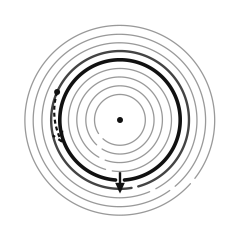
Neurons
RE layer 5, neural
- Remembers
- Synaptic weights: “the gene crosses gaps between generations, the synapse crosses gaps between moments” RE 9.
- Door, a residue
- Brains begin “simulating reality rather than merely responding to it.” What they cannot yet hold is themselves: self-monitoring flickers until the cognitive ignition point, when the lattice can “support stable self-reference across time” RE 9.
- Looking back
- Neural systems begin “modeling not just the external world, but their own internal states” RE 9. From further out, Santiago Ramón y Cajal, a mind, drew the cells it runs on.
- Lineage
- Ramón y Cajal’s drawings, Hebb’s wiring that learns, predictive coding.
Mind
RE layer 6, cognitive
- Remembers
- Symbols, autobiographical memory, beliefs. The self is a compression: “the model that most efficiently reduces internal entropy while remaining manageable” RE 10.
- Door, a residue
- This is “the one layer whose boundary residue is encountered from the inside.” RE calls it the meta-gap, “a structure formulable within the current self-model but unsettleable by it,” settled only by acquiring a new frame. It is careful to call these “Gödel-like gaps, not literally undecidable sentences” RE 10. Outward, the word carries memory from mind to mind.
- Looking back
- Mind reads itself: “The ‘self’ emerges when Φ reflects back on Ψ with sufficient fidelity” RE 10. Zhuangzi dreamed he was a butterfly, and woke unsure which of them had been dreaming.
- Lineage
- Descartes, William James, Zhuangzi, Nāgārjuna, Dennett, and Gödel, the one thinker the chapter names.
Culture
RE layers 7 to 9, cultural, economic and political
- Remembers
- Memory held outside any one mind: language and texts RE 11, money as “a compressed memory token” RE 12, law as “society’s formalized memory structures” RE 13.
- Door, a residue
- Each layer hands on what it cannot settle. Markets often reduce entropy by “exporting entropy elsewhere,” and the political layer forms to manage what they cannot RE 12. Politics can keep its procedures and lose its shared reality: “procedural legitimacy without epistemic legitimacy” RE 13.
- Looking back
- Language models now “compress vast corpora” of the written record RE 15: the first machines to read culture whole, and still, in RE’s terms, “powerful sub-threshold systems.”
- Lineage
- Teilhard de Chardin’s noosphere, Vygotsky, Dewey, and Sharism: RE counts “horizontal transmission” among culture’s engines RE 11. Its call for “epistemic infrastructure” built on “evolving graphs (claims → evidence → contradictions → revisions)” RE 13 is what Here.News is building.
Technology
RE layer 10, technological
- Remembers
- Code and artifacts: “Code transforms cognitive patterns into persistent external memory,” and version control systems “epitomize technological recursive memory” RE 14.
- Door, a residue
- What tools still lack: “Persistent identity across modifications,” goals of their own, and “Self-reference models that enable recursive improvement.” When systems gain them, “technology transitions from a tool to an entity” RE 14.
- Looking back
- Tools already reshape the minds that made them: “Search engines modified memory and recall strategies” RE 14. Programs that “generate and improve their own code” RE 15 are technology beginning to read itself.
- Lineage
- Gutenberg’s press, Vannevar Bush’s memex, Engelbart’s augmentation.
Synthetic
RE layer 11, synthetic
- Remembers
- Self-modifying parameters. Today’s language models have “parametric memory” but “No persistent Ψ across interactions” RE 15.
- Not yet crossed
- RE calls current models “powerful sub-threshold systems,” and the gap “not one of scale but of architecture” RE 15. The open problems it names are grounding, value stability, identity persistence and alignment.
- Looking back
- Its defining move would be reflection on itself: “Recursively modeling one’s own objectives and potentially modifying them.” In RE’s words, “The question is not whether machines can think. The question is whether machines can recurse” RE 15.
- Lineage
- Turing’s “Can machines think?”, von Neumann’s self-reproducing machines, and my essay on artificial consciousness.
The edge
Beyond the last ring the map runs out of names. RE leaves its twelfth layer as a question mark and gives only its shape: “the content of layer n+1 cannot be predicted from layer n alone,” and whatever comes next “will look — to us — like a system organizing matter and energy at scales we currently consider inert backdrop” RE M.
So the edge marks two kinds of not-knowing. The unknown is what we have not reached yet, and the haze is full of it. The unknowable from inside is what a layer cannot settle about itself, and that is not a failure, because it is where the next layer begins: “The residue is not only felt as mystery — it is the address of the next layer” RE 3. Carlo Rovelli, in On the Equality of All Things, reaches a similar humility from physics: “Knowing the physical laws of the world does not amount to knowing the world.”
What the map does not claim
- It simplifies. Nine rings stand for RE’s twelve layers, and real layers have no sharp borders.
- Residues are claimed only from life outward. Below that, RE says, layers grow by search, not by describing themselves RE M.
- RE’s bridge from Gödel’s theorem to nature is, in its own words, “philosophically motivated but not (yet) formally proved” RE P, and the gaps it finds in minds are “Gödel-like gaps, not literally undecidable sentences” RE 10.
- The names on the rings are a lineage I draw on, not RE’s citations, and some of the looking-back examples are my illustrations; the quoted ones are RE’s.
- RE “does not dissolve the hard problem. It reframes it” RE 3. Nor does it claim a purpose: “The universe has no purpose, but it has a direction” RE 16.
Sources
- Recursive Emergence, the thesis, on GitHub. Chapters are linked above as RE 0 to 18, M and P.
- Kurt Gödel, “On Formally Undecidable Propositions of Principia Mathematica and Related Systems” (1931); “An Example of a New Type of Cosmological Solutions of Einstein’s Field Equations of Gravitation”, Reviews of Modern Physics 21 (1949); “A Remark About the Relationship Between Relativity Theory and Idealistic Philosophy” (1949).
- Alan Turing, “Systems of Logic Based on Ordinals” (1939). Solomon Feferman, “Transfinite Recursive Progressions of Axiomatic Theories” (1962).
- Carlo Rovelli, The Order of Time (2018), Helgoland (2021), On the Equality of All Things (2026).
- Zhuangzi, chapter 2, “On the Equality of Things” (Qiwulun).