A Continuum of Recursive Emergence
Everything that persists is a recursion that earned its survival.
I’m Isaac Mao. I follow one pattern wherever it leads, from the first stars to the code we write today. I call it Recursive Emergence (RE):
Structures that recursively reduce local entropy while generating reusable memory persist, duplicate, and seed the conditions for the next layer of complexity to emerge.
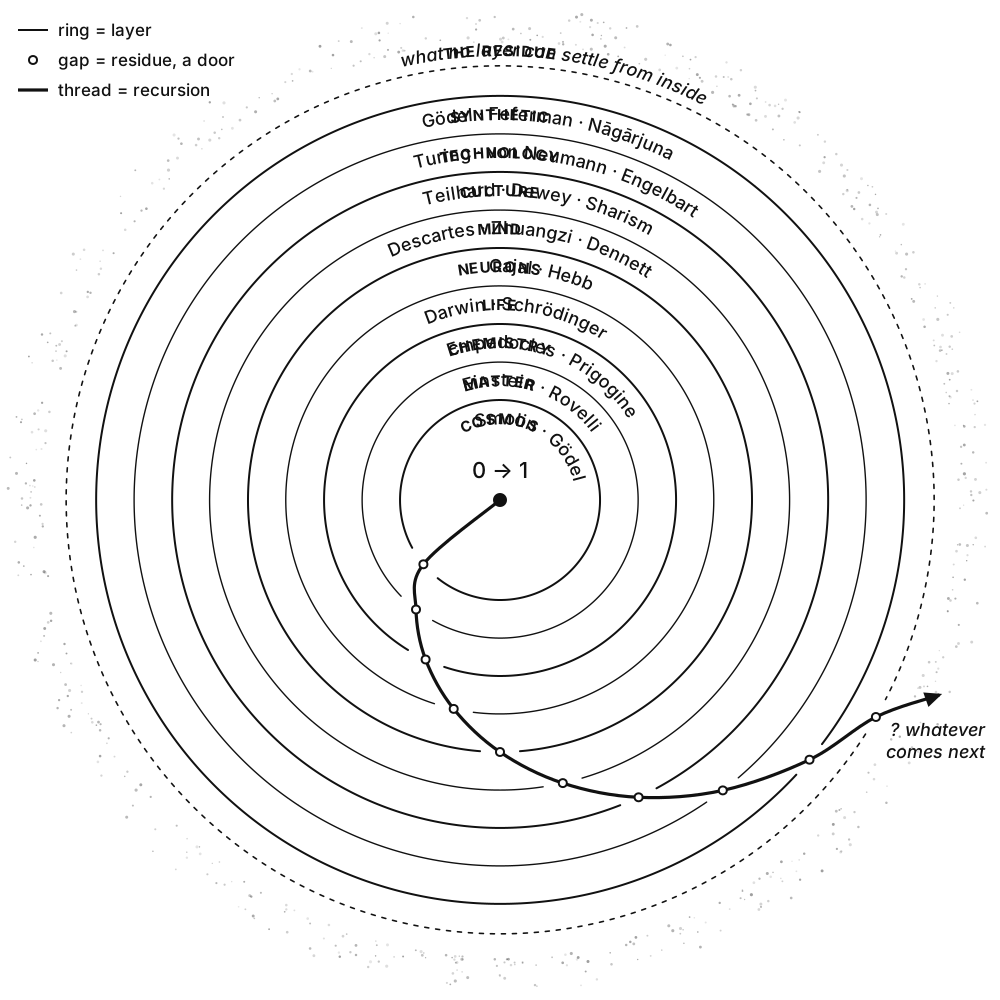
Each ring is a layer, each gap a door. From life outward the door is a residue, something a layer can state about itself but cannot settle from inside. Recursion extends out through the doors and reflects back in, never quite closing the loop. How to read the map.
The same shapes, over and over
A river seen from a hill looks like a tree lying down. The tree looks like the lines on a hand, and the hand like lightning. RE starts from that resemblance. Empedocles imagined elements joining and parting. Ilya Prigogine showed matter organizing itself far from equilibrium. Charles Darwin found recursion in the living, and Erwin Schrödinger described life as order that keeps itself by exporting disorder. Santiago Ramón y Cajal drew the branching neuron, and Donald Hebb the wiring that learns. Roger Penrose and Lee Smolin even imagined universes born from universes.
Different scales, one move: whatever remembers itself well enough gets to build on itself.
Time is memory
In 1949, for Einstein’s seventieth birthday, Kurt Gödel found an exact solution to Einstein’s equations in which time curves back on itself: a rotating universe where an observer could, in principle, return to their own past. It is not our universe. It needs a cosmos that rotates, does not expand, and has a negative cosmological constant. But Gödel drew a lesson from it: the passing of time may not be objective, which puts him closer to Kant than to the clock. Carlo Rovelli, in The Order of Time, argues that time as we live it is not a basic ingredient of the world either.
RE gives that intuition a mechanism. The arrow of time is the arrow of memory: a system with no memory has no time, and every new layer is time thickening as structure accumulates.
No view from nowhere
René Descartes found the self in doubt, William James in a stream, Daniel Dennett in a useful illusion. Zhuangzi dreamed he was a butterfly, and woke unsure which of them was dreaming. In his new book, On the Equality of All Things, Rovelli sets Zhuangzi and Nāgārjuna beside relational quantum physics and reaches the same place from physics: “we never leave the circle of perspectives.”
RE agrees, with one addition. The self is a compression, the pattern a system keeps of itself: not an illusion, and not outside the map either. Every map has someone looking at it, and the one looking is drawn in.
The residue
Then the hardest gift. Gödel proved that any consistent formal system rich enough for arithmetic contains true statements it cannot prove from within. Every such system has an edge.
Most people read that as a wall. I read it as a door. Add the unprovable statement and you get a larger system, with a new edge of its own; Alan Turing and Solomon Feferman showed you can keep walking through these doors without end. RE calls what is left over the residue, and treats it as the address of the next layer. Completeness would be the end of emergence, not its perfection.
The thread also runs back. Every layer able to describe itself reflects on the layers it came from, and it is that self-description that shows it its residue. The continuum maps both motions, layer by layer.
So there are two kinds of not-knowing. The unknown is what we have not reached yet. The unknowable from inside is what no layer can settle about itself, and it is not a failure: it is where the next layer begins. Rovelli arrives at a similar humility from physics: “Knowing the physical laws of the world does not amount to knowing the world.”
RE’s bridge from Gödel’s logic to the natural world is a philosophical one, not yet a formal proof, and it says so.
Endings feed beginnings
Culture is memory shared. Pierre Teilhard de Chardin imagined a noosphere, Lev Vygotsky learning through others, John Dewey knowledge as doing. My own contribution there is Sharism: the more we share, the faster a culture can remember and recombine. Alan Turing, John von Neumann, Vannevar Bush, and Douglas Engelbart turned thought into machinery and augmentation. I try to carry that line forward with Here.News and with questions about artificial consciousness.
As for me: an accessibility-friendly Homo sapiens who cares about generosity, curiosity, music as coherence, and freedom, keeping company along the way with Dawkins, Brand, Sagan, Rovelli, Nietzsche, and Einstein.
When an old tree falls, the young ones growing from it are not the old tree, but they remember it.
The universe has no purpose, but it has a direction. And the direction is toward more of itself knowing itself.
An ending, and a beginning. A zero, and a one.